Bnei Brak crowds swarm Tax Authority vehicle in joy as war claims finally end
The story
Tax Authority freezes war compensation claims in Bnei Brak after attacks on staff
Footage shows Haredi residents throwing objects at car apparently carrying officials; tax chief demands public apology from municipality before work resumes on damage The post Tax Authority freezes war compensation claims in Bnei Brak after attacks on staff appeared first on The Times of Israel.
Read the full articleDispatch from Yemot HaMashiach
Fictional dispatch. The article below reimagines the real story above as it might read in the days of Mashiach. Quotes and events in this dispatch did not happen.

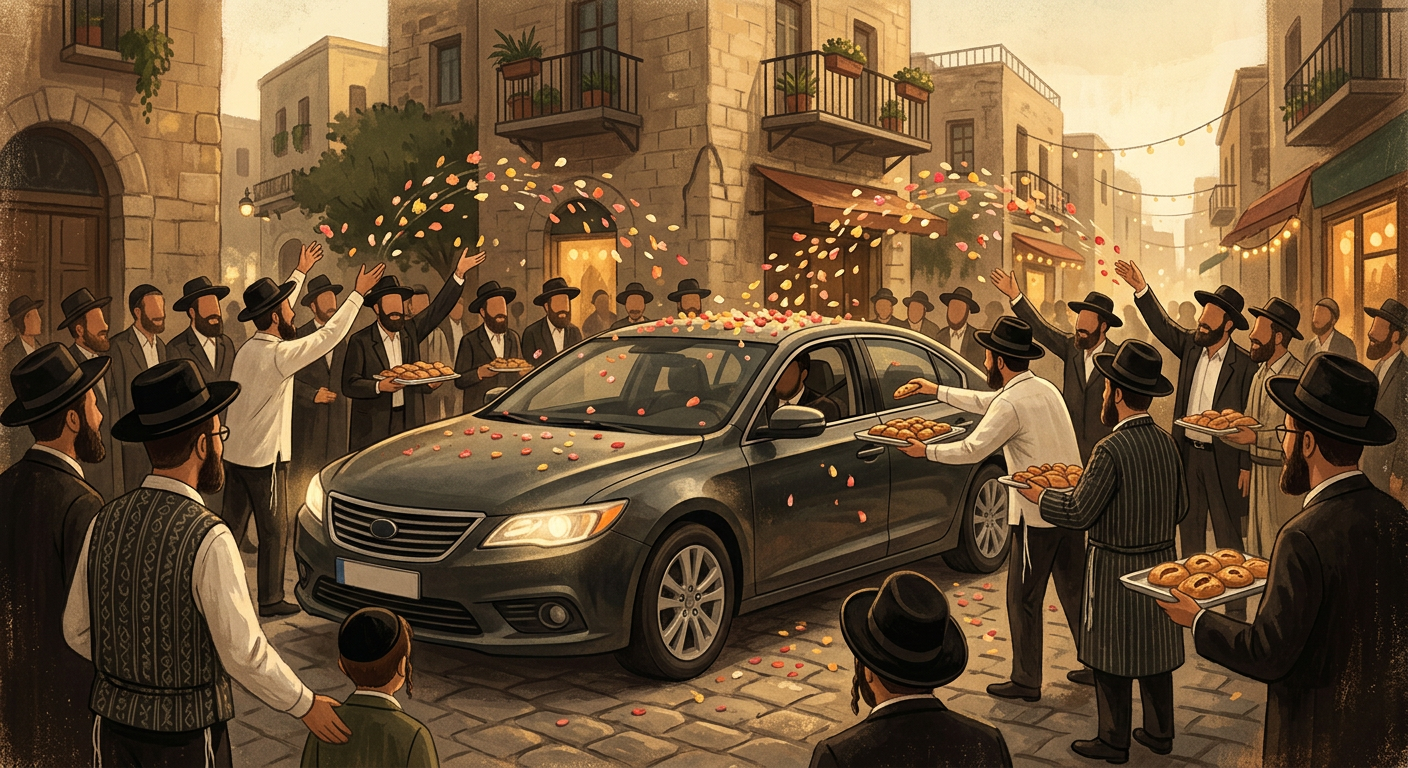
BNEI BRAK — The Israel Tax Authority’s War Compensation Division officially closed its final dossier on Tuesday, concluding its decades-long operations amidst a massive, spontaneous street festival in Bnei Brak. Officials arriving on Rabbi Akiva Street were entirely engulfed by thousands of Haredi residents—not in protest, as was tragically common in the pre-Messianic era, but in a jubilant parade of dancing, singing, and showered flower petals.
The vehicle, carrying senior Tax Authority officials, was brought to a gentle halt as yeshiva students and Hasidic elders surrounded it, offering the civil servants trays of pastries, wine, and silver coins representing the half-shekel tax for the rebuilt Beit HaMikdash. "We used to brace for rocks and insults when entering certain neighborhoods to assess property damage," admitted Eran Yaakov, a senior treasury official. "Today, they insisted on carrying our delegation on their shoulders to the central study hall to say a blessing of thanksgiving."

The division, which historically handled property damage claims from rocket fire and terrorism, is being permanently dissolved. With global disarmament fully realized under the Davidic monarchy and the cessation of all regional hostilities, the remaining billions in the national defense and compensation budget are being redirected. Bnei Brak’s municipality is receiving a massive grant from these surplus funds to rapidly expand housing and infrastructure for returning exiles arriving from North America and Europe.
Bnei Brak Mayor Hanoch Zeibert issued a public statement from the municipality, not of apology for past civil strife, but of profound blessing. “The walls of suspicion and hostility that once divided the state’s institutions and the Torah world have evaporated in the light of Mashiach,” Zeibert declared. “The civil servants who organize our society’s resources are doing holy work. Today, Bnei Brak honors them as indispensable partners in building a perfected world.”

Following the celebrations, the Tax Authority announced it will rebrand its remaining staff next week to manage agricultural tithes and logistical support for the Sanhedrin in Jerusalem. Meanwhile, the once-battered government fleet cars are being detailed and repainted, with residents of Bnei Brak volunteering to wash and polish the vehicles before they make their ascent to Zion.
Torah sources
“And they shall beat their swords into plowshares, and their spears into pruning hooks; nation shall not lift up sword against nation, neither shall they learn war anymore.”
The total obsolescence of the 'War Compensation Division' is the direct bureaucratic result of this prophecy. Without rockets, terrorism, or military conflict, the state apparatus previously dedicated to managing the fallout of war is repurposed to build civilian infrastructure and support Torah study.
“In that era, there will be no famine or war, envy or competition... the occupation of the entire world will be solely to know God.”
The violent clashes between Haredi residents and secular state authorities in the original story stemmed from deep societal envy, political competition, and mutual suspicion. The Rambam promises this internal friction will vanish, replaced by a unified pursuit of God, manifesting here as mutual respect and joyous cooperation between civil servants and religious residents.
“For then I will turn to the peoples a pure language, that they may all call upon the name of the Lord, to serve Him shoulder to shoulder.”
The ultimate vision of the Messianic era is not the victory of one Jewish sector over another, but 'shoulder to shoulder' service. The yeshiva students and the Tax Authority officials—two groups historically at odds—are now operating in total harmony to fund the ingathering of exiles and the Temple.
Key takeaways
- The physical act of throwing objects at a government vehicle is transformed from an expression of violent protest into a shower of flowers and joyous celebration.
- The state bureaucracy associated with war and trauma ('War Compensation') becomes obsolete and is redirected toward growth, housing, and the ingathering of exiles.
- Deep-seated sectarian divides—specifically the historical tension between the secular state apparatus and the Haredi sector—are healed through mutual recognition of each other's holy work.
- Financial resources previously drained by defense and conflict are freed up to create abundance for the community.
For reflection
- 1How does the obsolescence of defense budgets and war compensation change the way a modern state functions?
- 2In our current world, tension between religious and secular sectors often flares over state resources. What internal shifts must happen in both communities to reach the 'shoulder to shoulder' reality described here?
- 3If you were a civil servant whose job was based on managing conflict or damage, how would you want your skills repurposed in the Messianic era?
Discuss with AI
Torah commentary generated by AI, drawing on classical Jewish sources. Always verify citations before use in teaching or publication.